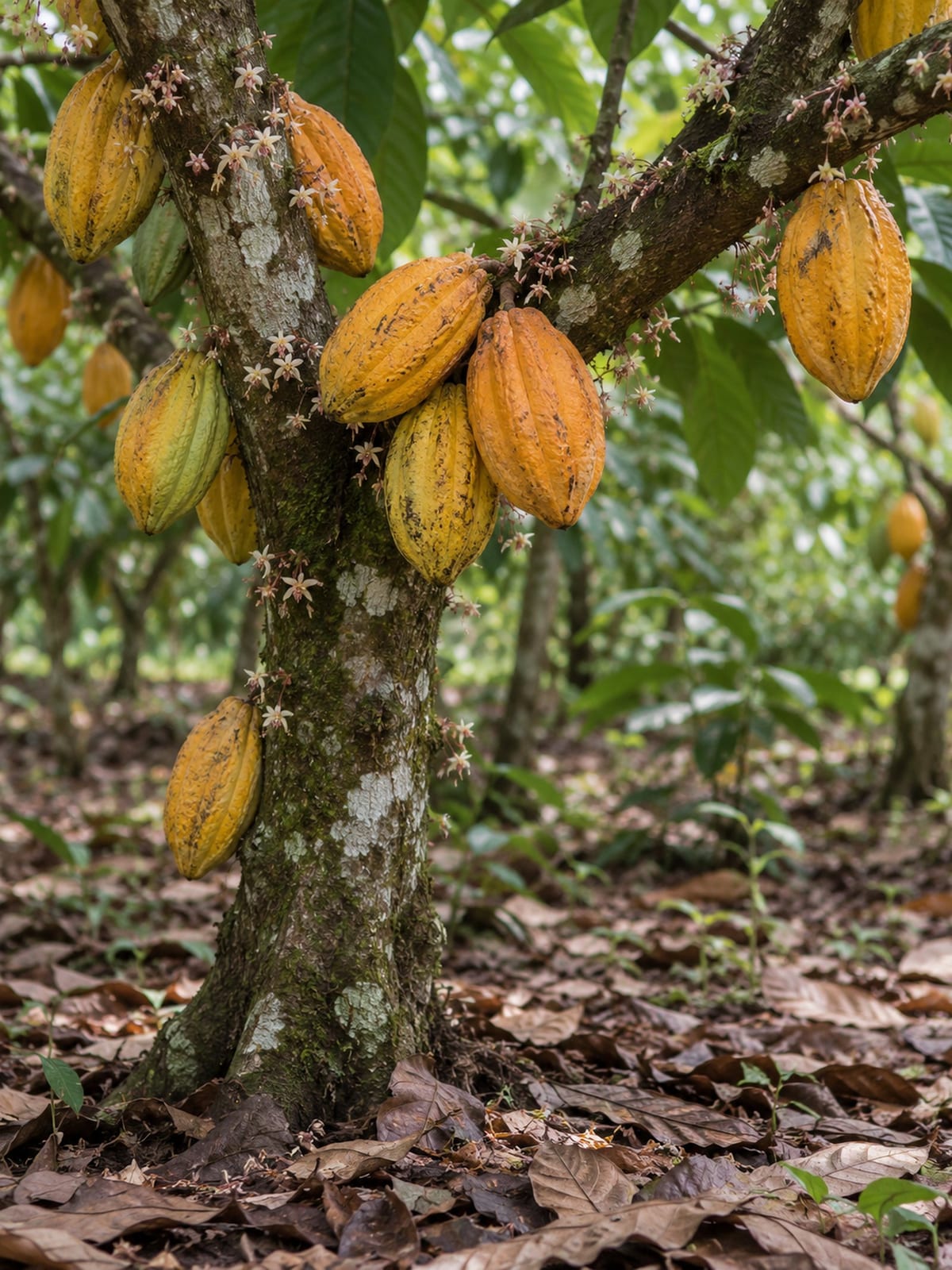
Industrial · Understorey tree, pruned to about 3.5 m

Cocoa

Theobroma cacao · Kakao · Malvaceae

An understorey tree grown under light shade. Cocoa pod borer, black pod and vascular streak dieback cause most losses, so weekly harvesting, sanitation and pruning matter most. In Sulawesi, side grafting with superior clones is widely used to renew old trees.

  • Humid lowland tropics
  • Tree crop

Summary of cited sources. TERAknow summarises published guidance from the sources linked on each page. Recommendations are general, not guaranteed: results depend on your soil, climate and variety, so confirm with local extension staff or an agronomist before acting.

Key facts

Site and soil at a glance

Soil pH
6.0 to 7.0 optimal; 5.0 to 6.0 marginal[1]
Climate
1,500 to 2,500 mm rain/yr; 0 to 600 m altitude[1]
Spacing
3 x 3 m to 4 x 4 m, by clone size[2]
Shade
About 75% of full sunlight reaching the cocoa[3]
Tree height
Keep below about 3.5 m[2]
Harvest
Pods ripen in 5 to 6 months; pick weekly[2]
Soil pH band: 6.0 to 7.0
Good practice

Practices by growth stage

Pick a stage, topic or approach to narrow the list. Open a card for technical detail and its sources.

Growth stage
Topic
Approach

Showing 11 of 11 practices.

    • Biological & regenerative
    • Crop care
    • Stage: Site & shade

    Establish light Gliricidia shade

    Cocoa needs light shade. Gliricidia grows quickly from cuttings and is the main shade tree in PNG guides.

    Technical detail
    • PNG handbook: plant sticks about 1 m long and 5 cm thick; they give useful shade in 6 to 9 months. Thin temporary shade over years 2 to 4.
    • ACIAR: about 75% of full sunlight is ideal. Pacific Pests suggests light shade of about 600 shade trees per hectare to limit black pod.
    • Prune shade before the main flowering period.
    Regions
    Pacific · Widely applicable
    Confidence
    High confidence: several institutional sources agree
    • Biological & regenerative
    • Soil biology
    • Stage: Site & shade

    Choose companion trees that build soil

    A Southeast Sulawesi study found more soil carbon, nitrogen and aggregation under shade-tree canopies, with no net effect of shade on cocoa yield. Gliricidia gave the best results for soil carbon.

    Technical detail
    • ICRAF species cards (South Sulawesi) use 3.8 m x 2.5 m cocoa spacing and put teak, mahogany and sengon on farm boundaries.
    • Nitrogen-fixing companions such as petai, jengkol and sengon are noted for soil fertility.
    • Planting companions too close reduces yields of both crops.
    Regions
    Indonesia (Sulawesi)
    Confidence
    Medium confidence: one institutional guide
    • Core practice
    • Establishment
    • Stage: Site & shade

    Plant on deep, well-drained land with room between trees

    Cocoa prefers deep soil near neutral pH. Avoid poorly drained heavy clay, where black pod is worse.

    Technical detail
    • BPTP Bengkulu: effective depth above 150 cm, loam-sand to clay-loam texture, pH 6.0 to 7.0 optimal.
    • Pacific Pests: plant at least 3 m apart; on slopes, choose sites with morning sun so leaves dry quickly.
    • PNG handbook: 4 m x 4 m for big clones; 4 m x 3 m or 3 m x 3 m for small clones.
    Regions
    Indonesia · Pacific
    Confidence
    High confidence: several institutional sources agree
    • Core practice
    • Crop care
    • Stage: Formation

    Prune to an open, low canopy

    An open canopy dries fast, which reduces black pod, and a low tree makes weekly picking possible.

    Technical detail
    • PNG handbook: start formation pruning 6 months after planting, aiming for a trunk up to 50 cm with 5 main branches by about 2 years.
    • Maintenance: cut shoots above 3.5 m and branches drooping within 1.2 m of the ground. Prune lightly each month and more strongly twice a year after the harvest peaks.
    • Pacific Pests (pod borer): prune every 6 months and keep trees no more than 3 m tall.
    Regions
    Pacific · Indonesia
    Confidence
    High confidence: several institutional sources agree
    • Conventional
    • Soil & nutrition
    • Stage: Mature trees

    Feed weeded trees after the harvest

    Fertiliser works only on well-weeded trees. Ring-weed about 1 m around the trunk a month before applying.

    Technical detail
    • ACIAR (PNG): 50 g urea or 120 g NPK per mature tree, twice a year. These are rates from one guide; adjust to a soil test.
    • In Bengkulu, farmers applying N and P irregularly had leaves low in N and P, while soil K was high.
    • Composted chicken manure at least 3 months old can be added, up to 10 kg per tree twice a year in the ACIAR manual.
    Regions
    Pacific · Indonesia
    Confidence
    High confidence: several institutional sources agree
    • Biological & regenerative
    • Soil biology
    • Stage: Mature trees

    Recycle litter, prunings and buried husks

    Leaf litter protects the soil and reduces rain splash. Husks and prunings return nutrients, but must be buried because they carry disease and pests.

    Technical detail
    • ACIAR: leave fallen leaves as mulch, with a 20 cm clear space around the trunk. Mulch improves moisture and stimulates microbial activity.
    • PNG handbook: bury husks, prunings and manure about 10 cm deep in trenches between rows, alternating direction each year.
    • BPTP Bengkulu linked high soil K partly to pod husks spread on the land.
    Regions
    Pacific · Indonesia
    Confidence
    High confidence: several institutional sources agree
    • Core practice
    • Pests & disease
    • Stage: Harvest & fermentation

    Beat pod borer with complete, frequent, regular harvest

    Pod borer larvae feed inside pods and leave them in about 2 to 3 weeks. Picking every pod as it turns yellow, weekly, breaks the cycle before moths emerge.

    Technical detail
    • Pacific Pests: harvest at 7-day intervals, do not miss mature pods, and bury infested pods. It works best when neighbours do the same.
    • ACIAR: weekly in the rainy season and fortnightly in the dry season. Pacific Pests notes that ants (Iridomyrmex) commonly prey on 40 to 60% of the pest.
    • In Central Sulawesi trials, sex pheromone traps helped reduce infestation. Pacific Pests does not recommend pesticides for smallholders.
    Regions
    Indonesia (Sulawesi) · Pacific
    Confidence
    High confidence: several institutional sources agree
    • Conventional
    • Pests & disease
    • Stage: Mature trees

    Remove black pods; use copper or phosphonate if needed

    Black pod spores splash from soil and infected pods. Sanitation and an open canopy come first; fungicides support them in the wet season.

    Technical detail
    • Pacific Pests: remove diseased pods at least monthly, more often in the main crop. The PNG handbook says weekly. Bury or burn husks.
    • Pacific Pests: copper sprays on pods every 2 weeks in the main crop season, or phosphonate trunk injections once or twice a year.
    • Use only locally registered products and follow the label.
    Regions
    Pacific · Widely applicable
    Confidence
    High confidence: several institutional sources agree
    • Core practice
    • Pests & disease
    • Stage: Mature trees

    Use resistant clones and cut out VSD branches

    Vascular streak dieback (VSD) infects young leaves in wet weather and shows 3 to 5 months later. Protectant fungicides do not work, so resistant planting material is the main tool.

    Technical detail
    • PNG handbook: prune infected branches 30 cm below the lowest symptom, especially before the wet season, and bury the cuttings.
    • Pacific Pests: pruning helps mainly on varieties with some resistance. Do not move plants from infested areas; quarantine for 3 months.
    Regions
    Pacific · Indonesia
    Confidence
    High confidence: several institutional sources agree
    • Core practice
    • Establishment
    • Stage: Rehabilitation

    Renew old trees by side grafting (sambung samping)

    Side grafting puts a superior clone onto an existing tree. The old tree keeps bearing until the graft fruits, which Balittri reports can be about 18 months.

    Technical detail
    • Balittri: graft in the dry season, in the morning or late afternoon. Heavy rain after grafting causes failure. The rootstock must be actively growing, with bark that lifts easily.
    • Scions: brown-green fan branches 0.75 to 1.5 cm thick with 3 to 5 buds, from clearly identified high-yielding clones. Make a 5 cm cut 45 to 60 cm above the ground, insert a 3 to 4 cm wedge, tie with raffia and cover with a plastic bag. Check at 5 days.
    • In Central Sulawesi, overall graft success was about 95%, with Sulawesi 1, Sulawesi 2, UIT 1 and TSH 858 doing well. Local scion sources limit moving pests between regions.
    Regions
    Indonesia (Sulawesi)
    Confidence
    High confidence: several institutional sources agree
    • Core practice
    • Harvest
    • Stage: Harvest & fermentation

    Pick ripe pods and ferment for up to 6 days

    Harvest pods as soon as they ripen: green pods turn yellow and red pods turn orange. Ferment in boxes and turn the mass daily.

    Technical detail
    • PNG handbook: pods can wait up to 2 days before breaking. Break them with a blunt stick, not in rain.
    • Fill boxes at least 50 to 65 cm deep, cover with banana leaves, turn every 24 hours, and stop at 6 days. The mass peaks around 50 °C on day 4.
    • Sun-dry in a layer about 2 cm deep, raking often. Bengkulu farmers harvest once a week.
    Regions
    Pacific · Indonesia
    Confidence
    Medium confidence: one institutional guide
Regional notes

How practice differs by region

  • Indonesia (Sulawesi)

    Side grafting with local superior clones such as Sulawesi 1 and 2, pheromone traps for pod borer, and companion trees chosen with ICRAF species cards.

  • Papua New Guinea

    The CCIL handbook uses Gliricidia shade, monthly maintenance pruning, weekly pod removal and 6-day box fermentation.

  • Research gap

    Indonesia fertiliser rates

    Indonesian cocoa fertiliser recommendations by soil type still to be added.

Common mistakes

What to avoid, and what to do instead

  • AvoidLeaving husks and diseased pods on the ground.
    InsteadBury them about 10 cm deep, or compost them.
  • AvoidHarvesting only every few weeks.
    InsteadPick all ripe pods every 7 days.
  • AvoidLetting trees grow tall and dense.
    InsteadKeep trees below about 3.5 m with an open canopy.
  • AvoidSide grafting in the rainy season.
    InsteadGraft in the dry season, in the morning or late afternoon.
  • AvoidMoving plants from areas with VSD.
    InsteadUse clean planting material and quarantine new plants.
Sources

Numbered sources

This page summarises the sources below. Check the original documents for full context.

  1. Pengaruh Kesuburan Tanah dan Kebiasaan Petani terhadap Kandungan Hara dan Produksi Kakao di Sidomukti Bengkulu Utara (opens in a new tab)Basri I.H., Farmanta Y., Hamdan; BPTP Bengkulu (data from 2005 to 2006)
  2. Papua New Guinea Cocoa Farmer's Handbook (opens in a new tab)Nongkas A. and Keane P. (eds); PNG Cocoa and Coconut Institute Ltd (CCIL), 2017
  3. Integrated Pest and Disease Management for Sustainable Cocoa Production (2nd ed.) (opens in a new tab)Konam J., Namaliu Y., Daniel R., Guest D.I.; ACIAR Monograph 131, 2011
  4. Cocoa black pod (Fact sheet 006) (opens in a new tab)Tsatsia H. and Jackson G.; Pacific Pests, Pathogens, Weeds & Pesticides, 2025
  5. Soil fertility and Theobroma cacao growth and productivity under commonly intercropped shade-tree species in Sulawesi, Indonesia (opens in a new tab)CIFOR-ICRAF publication page for a Plant and Soil article (DOI 10.1007/s11104-018-03921-x, about 2018)
  6. Farmer Species Cards: Companion Crop and Management Options for Smallholder Cacao Agroforestry Systems (opens in a new tab)Riyandoko, Roshetko J.M., Saputri Y. et al.; CIFOR-ICRAF Indonesia and Mars Symbioscience Indonesia, 2024
  7. Cocoa pod borer (Fact sheet 175) (opens in a new tab)Jackson G.; Pacific Pests, Pathogens, Weeds & Pesticides, 2025
  8. Study on adaptation of several clones as the side-cleft-grafting material of cocoa in Central Sulawesi (opens in a new tab)Saidah, Negara A., Sahardi (BPTP Central and South Sulawesi); Prosiding Seminar Nasional Masyarakat Biodiversitas Indonesia 1(7), 2015
  9. Cocoa vascular streak dieback (Fact sheet 223) (opens in a new tab)Jackson G.; Pacific Pests, Pathogens, Weeds & Pesticides, 2025
  10. Rehabilitasi Kakao Rakyat dengan Sambung Samping (opens in a new tab)Tjahjana B.E. and Sobari I.; Balittri (Balai Penelitian Tanaman Industri dan Penyegar), SIRINOV 2(1), 2014
  11. Pemuliaan Tanaman Partisipatif dan Teknik Sambung Samping dalam Perakitan Varietas Unggul Baru Kakao Tahan Penggerek Buah Kakao (opens in a new tab)Sulistyorini I., Rubiyo, Tresniawati C.; Balittri, SIRINOV 4(2), 2016
THE NEXT STEP
LET'S CULTIVATE PROGRESS

Better soil starts
with better decisions.

Turn soil insights into practical action, from testing to targeted improvement.