
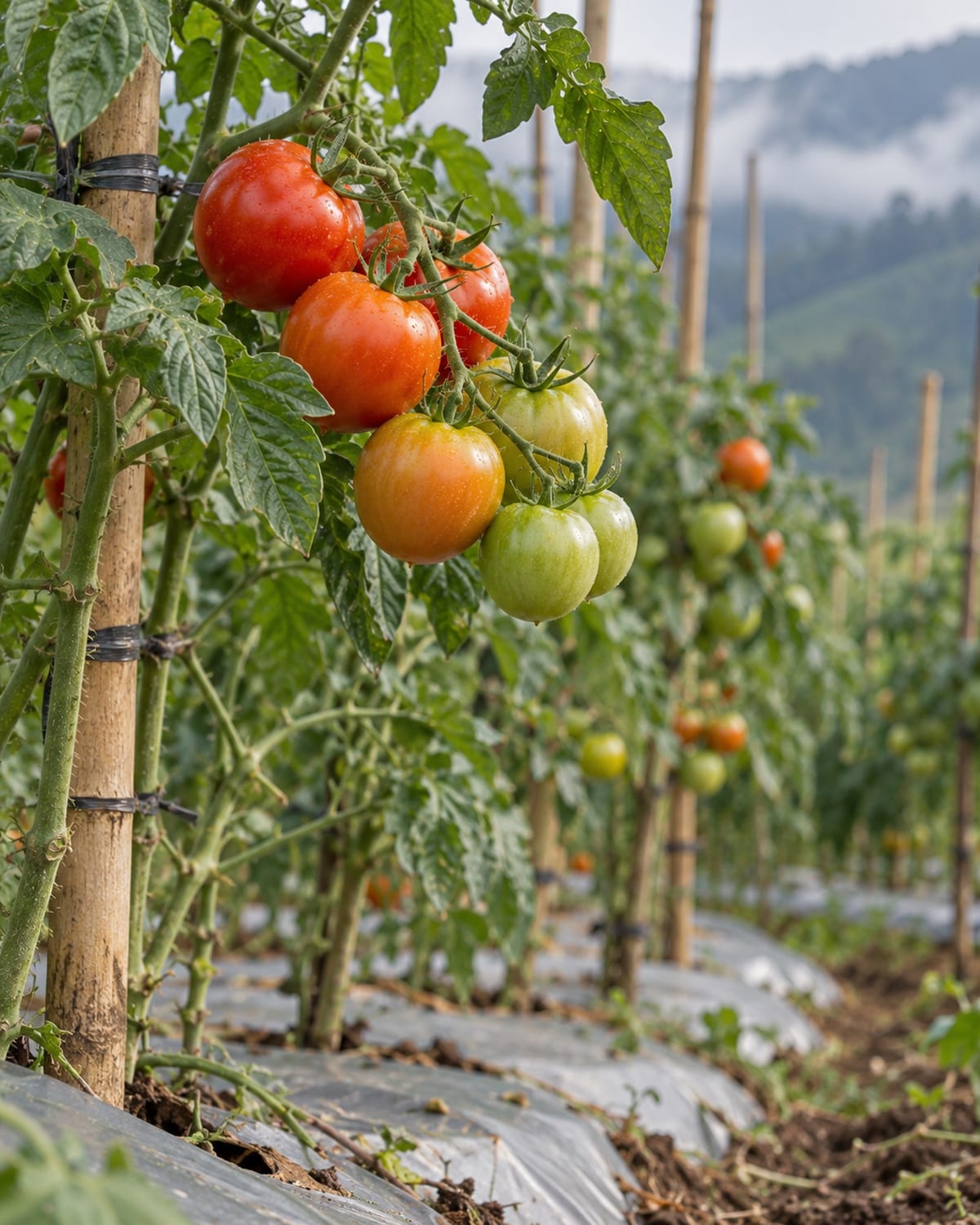
Vegetables · Annual vine, staked and pruned

Tomato

Solanum lycopersicum · Tomat · Solanaceae

A widely grown fruit vegetable that is picked many times. In the humid tropics, bacterial wilt, flooding and whitefly-spread yellow leaf curl viruses are the main threats, so raised beds, screened nurseries, grafting and rotation do most of the work.

  • Tropical & subtropical
  • Annual

Summary of cited sources. TERAknow summarises published guidance from the sources linked on each page. Recommendations are general, not guaranteed: results depend on your soil, climate and variety, so confirm with local extension staff or an agronomist before acting.

Key facts

Site and soil at a glance

Soil
Loose, humus-rich, well-drained clay loam with sand[1]
Soil pH
5 to 6 in one Indonesian guide[1]
Beds
110 to 120 cm wide, 20 to 30 cm high, 50 cm drains[1]
Spacing
50 to 60 cm x 40 to 50 cm[1]
Grafting
At 2 to 3 true leaves, about 14 to 16 days after sowing[2]
Harvest
10 to 15 pickings at 2 to 3 day intervals[1]
Soil pH band: 5.0 to 6.0
Good practice

Practices by growth stage

Pick a stage, topic or approach to narrow the list. Open a card for technical detail and its sources.

Growth stage
Topic
Approach

Showing 11 of 11 practices.

    • Core practice
    • Establishment
    • Stage: Nursery

    Raise seedlings under insect netting

    Yellow leaf curl viruses are spread by whitefly, and infected seedlings carry the virus to the field. Grow seedlings in a screened nursery from whitefly-free sources.

    Technical detail
    • BPTP Jawa Timur (chili guide; tomato is also a host): isolate the nursery with 50-mesh gauze.
    • Queensland Government: source seedlings from an area free of viruses and whiteflies. The virus is not seed-borne.
    • Jambi guide: soak seed in warm water for at least 6 hours; transplant at 25 to 30 days or 3 to 4 true leaves.
    Regions
    Indonesia · Widely applicable
    Confidence
    High confidence: several institutional sources agree

    • Core practice
    • Establishment
    • Stage: Nursery

    Graft onto resistant eggplant rootstock where wilt or flooding is likely

    Bacterial wilt has no effective chemical control. Grafting tomato onto wilt-resistant eggplant rootstock protects against wilt and short flooding in the hot-wet season.

    Technical detail
    • WorldVeg guide: eggplant accessions EG195 and EG203 resist flooding, bacterial wilt, root-knot nematode and Fusarium wilt. Use a tomato rootstock (Hawaii 7996) only where flooding is not expected.
    • Tube grafting at 2 to 3 true leaves with matching stems of 1.6 to 1.8 mm. Heal in a shaded chamber at 25 to 32 C and above 85% humidity, then harden; about 30 to 33 days from sowing.
    • Keep the graft union above the soil, or scion roots can bypass the rootstock. Grafted plants cost more, so use them where soil-borne disease or flooding is a real risk.
    Regions
    Widely applicable
    Confidence
    High confidence: several institutional sources agree
    • Core practice
    • Soil & nutrition
    • Stage: Field establishment

    Plant on raised beds and correct acidity

    Raised beds with drains reduce waterlogging and bacterial wilt risk. Lime acid soils at least 3 weeks before planting.

    Technical detail
    • Jambi guide: beds 110 to 120 cm wide, 20 to 30 cm high, with 50 cm between beds as drains.
    • Lime about 300 kg/ha in furrows 15 to 20 cm from the row, 10 to 15 cm deep, at least 3 weeks before planting (one guide; adjust to a soil test).
    • Pacific Pests & Pathogens: plant on ridges or raised beds where drainage is poor.
    Regions
    Indonesia · Pacific
    Confidence
    High confidence: several institutional sources agree
    • Conventional
    • Soil & nutrition
    • Stage: Field establishment

    Basal NPK with a side dressing at 25 to 30 days

    Split nitrogen and potassium between planting and an early side dressing, and put all phosphate in at planting.

    Technical detail
    • Jambi guide (one source): urea 200 kg/ha, SP-36 250 kg/ha, KCl 100 kg/ha.
    • Apply half the urea and KCl plus all SP-36 at or before planting; the rest at 25 to 30 days, with weeding and hilling.
    • Adjust rates to a soil test and local recommendations.
    Regions
    Indonesia
    Confidence
    Medium confidence: one institutional guide
    • Biological & regenerative
    • Soil biology
    • Stage: Field establishment

    Manure, bokashi and straw mulch

    Organic matter keeps the soil loose and moist. Mulch also steadies soil moisture and temperature, which reduces blossom-end rot.

    Technical detail
    • Jambi guide: about 10 t/ha manure a week before planting, or about 5 t/ha bokashi.
    • Rock phosphate at 300 to 350 kg/ha can replace SP-36, applied at least 1 week before planting.
    • Dry straw mulch is listed against blossom-end rot and sunscald.
    Regions
    Indonesia
    Confidence
    Medium confidence: one institutional guide
    • Core practice
    • Crop care
    • Stage: Vegetative growth

    Stake early and prune to one or two stems

    Stakes carry the fruit load and keep fruit off the soil. Pruning indeterminate types improves airflow.

    Technical detail
    • Install a bamboo or wood stake 100 to 225 cm tall per plant as early as possible.
    • One-stem system: remove all side shoots. Two-stem system: keep the shoot just below the first flower cluster.
    • Prune on dry mornings, and remove diseased leaves and cracked fruit.
    Regions
    Indonesia
    Confidence
    Medium confidence: one institutional guide
    • Core practice
    • Water
    • Stage: Flowering & fruit set

    Keep soil moisture even

    Irregular watering causes fruit cracking, and uneven moisture is linked to blossom-end rot.

    Technical detail
    • Jambi guide: water 1 to 2 times a day early on, adjusted for weather, and do not let soil dry out.
    • Mulch helps hold moisture steady.
    • Never let beds stand in water, since wet, hot conditions spread bacterial wilt.
    Regions
    Indonesia · Widely applicable
    Confidence
    High confidence: several institutional sources agree
    • Core practice
    • Pests & disease
    • Stage: Vegetative growth

    Remove wilted plants and rotate away from the tomato family

    The wilt bacterium spreads through soil, water, tools and seedlings, and survives for years in debris. Hygiene and long rotations limit it.

    Technical detail
    • Remove wilted plants with surrounding soil and destroy them. Clean soil off tools, machinery and shoes.
    • Rotate at least 4 years away from solanaceous crops; maize, soybean, grasses and rice have worked.
    • No chemicals give satisfactory control except soil fumigants. Tolerant varieties exist; check local lines.
    Regions
    Widely applicable
    Confidence
    High confidence: several institutional sources agree
    • Biological & regenerative
    • Pests & disease
    • Stage: Field establishment

    Maize barrier rows, yellow traps and roguing against whitefly

    Physical and cultural barriers reduce the whitefly that spreads yellow virus, without relying on sprays.

    Technical detail
    • BPTP Jawa Timur (written for chili; tomato is a host): plant maize densely in 5 to 6 rows around the field 2 to 3 weeks before transplanting.
    • About 40 yellow sticky traps per hectare at roughly 30 cm height.
    • Monitor until 35 to 40 days, destroy diseased plants and remove weed hosts. Test locally on tomato.
    Regions
    Indonesia
    Confidence
    Medium confidence: one institutional guide
    • Conventional
    • Pests & disease
    • Stage: Field establishment

    Silver plastic mulch and targeted whitefly control

    Reflective silver-black plastic mulch deters whitefly. Where sprays are needed, use registered products within an IPM plan.

    Technical detail
    • BPTP Jawa Timur: silver-black plastic mulch reflects light that whiteflies avoid.
    • Queensland Government: control adult whiteflies before destroying old crops, remove old crops promptly after the final harvest, and keep weeds down.
    • Resistant varieties help only with good hygiene. Collect plastic after the crop.
    Regions
    Indonesia · Widely applicable
    Confidence
    High confidence: several institutional sources agree
    • Core practice
    • Harvest
    • Stage: Harvest

    Pick every 2 to 3 days at the stage the market needs

    Harvest starts about 2.5 to 3 months after planting and gives 10 to 15 pickings.

    Technical detail
    • Distant markets: pick at the green-ripe stage, when the blossom end shows yellow.
    • Nearby markets: pick when the blossom end turns pink or red.
    • Cut with scissors or twist gently to avoid bruising.
    Regions
    Indonesia
    Confidence
    Medium confidence: one institutional guide
Regional notes

How practice differs by region

  • Indonesia (lowlands)

    Indonesian guides use raised beds with drains, liming of acid soils, staking and pruning. Yellow virus is managed with screened nurseries, maize barriers and yellow traps.

  • Hot-wet tropics

    WorldVeg recommends grafting onto eggplant rootstocks EG195 or EG203 where flooding, bacterial wilt or nematodes are a real risk.

  • Research gap

    Highland Indonesia

    Highland practices, late blight management and current variety lists for tomato are still to be added.

Common mistakes

What to avoid, and what to do instead

  • AvoidRaising seedlings in the open where whitefly is active.
    InsteadUse a screened nursery and whitefly-free seedlings.
  • AvoidBurying the graft union at transplanting.
    InsteadKeep the union above the soil line.
  • AvoidFollowing tomato with chili, eggplant or potato on wilt-infested land.
    InsteadRotate for at least 4 years with maize, rice or other non-hosts.
  • AvoidLeaving old crops standing after the last harvest.
    InsteadControl whitefly, then remove and destroy the old crop promptly.
  • AvoidIrregular watering during fruiting.
    InsteadKeep moisture even and use mulch.
Sources

Numbered sources

This page summarises the sources below. Check the original documents for full context.

  1. Budidaya Tomat (opens in a new tab)Mugiyanto & Nugroho, H., IP2TP Kotabaru Jambi, Badan Litbang Pertanian, 2000
  2. Grafting Tomatoes for Production in the Hot-Wet Season (Publication 03-551) (opens in a new tab)Black, L.L., Wu, D.L., Wang, J.F., Kalb, T., Abbass, D. & Chen, J.H., AVRDC The World Vegetable Center, year not stated
  3. Pengendalian Penyakit Kuning pada Tanaman Cabai (opens in a new tab)Handayani, W., Handoko, Ulil, R. & Baswarsih, BPTP Jawa Timur, year not stated
  4. Tomato yellow leaf curl virus (opens in a new tab)Business Queensland, Queensland Government, updated 2025
  5. Eggplant accessions as bacterial wilt resistant rootstocks for grafted tomato (record 73988, abstract) (opens in a new tab)World Vegetable Center repository, Taiwan field trials
  6. Tomato bacterial wilt (Fact sheet 146) (opens in a new tab)Jackson, G., Pacific Pests, Pathogens, Weeds & Pesticides, 2025
THE NEXT STEP
LET'S CULTIVATE PROGRESS

Better soil starts
with better decisions.

Turn soil insights into practical action, from testing to targeted improvement.