
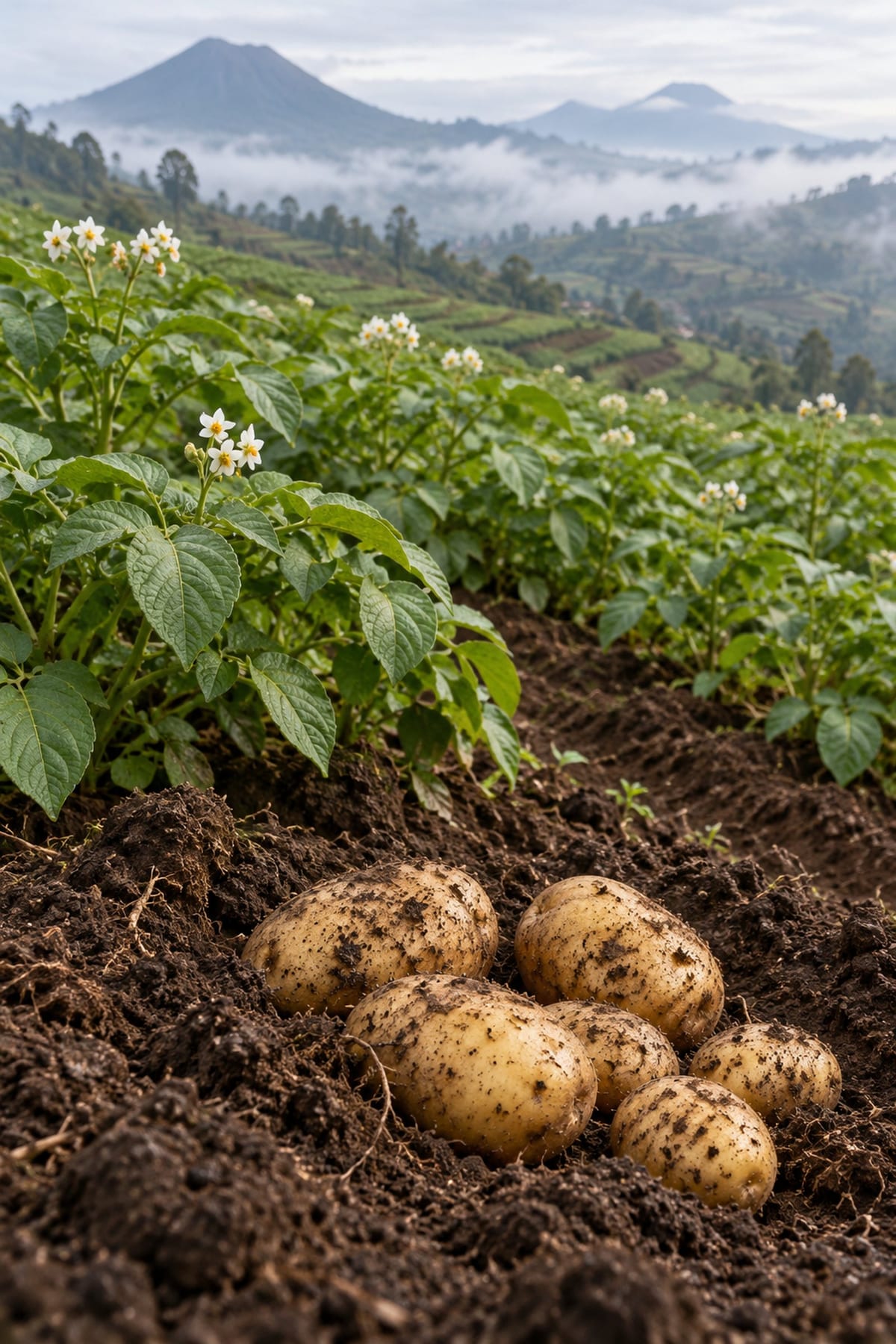
Vegetables · Annual herb grown from seed tubers

Potato

Solanum tuberosum · Kentang · Solanaceae

A cool-climate tuber crop grown in Indonesia mainly in highlands such as Dieng, Pangalengan and Tosari, often on steep slopes. Seed quality, late blight, bacterial wilt and soil erosion decide most outcomes.

  • Cool highlands
  • Tuber crop

Summary of cited sources. TERAknow summarises published guidance from the sources linked on each page. Recommendations are general, not guaranteed: results depend on your soil, climate and variety, so confirm with local extension staff or an agronomist before acting.

Key facts

Site and soil at a glance

Soil pH
Ideal 6 to 6.5; tolerates down to 5[1]
Seed classes
G0 to G3 source seed, G4 extension seed[2]
Seed tubers
Well-sprouted, disease-free, 40 to 50 g[3]
Spacing
80 x 35 cm in a Lembang trial[2]
Erosion
About 41 t/ha with beds running downslope at Tosari[4]
Harvest
90 to 100 days, or when plants yellow[5]
Soil pH band: 5.0 to 6.5
Good practice

Practices by growth stage

Pick a stage, topic or approach to narrow the list. Open a card for technical detail and its sources.

Growth stage
Topic
Approach

Showing 11 of 11 practices.

    • Core practice
    • Establishment
    • Stage: Seed selection

    Use certified seed tubers of a known class

    Seed tubers carry viruses, bacterial wilt and late blight. Certified seed has set disease limits for each class.

    Technical detail
    • Indonesia uses classes G0 to G4. G0 allows 0% virus and 0% bacterial wilt; G4 allows 2% virus and 1% bacterial disease (Mulyono et al. 2017).
    • Certified seed carries a white (G0), purple (G1) or blue (G2) label (Balitsa 2021).
    • Pacific Pests & Pathogens: use certified seed, and source seed potatoes from crops monitored free of bacterial wilt for 2 years.
    Regions
    Indonesia · Widely applicable
    Confidence
    High confidence: several institutional sources agree
    • Core practice
    • Establishment
    • Stage: Seed selection

    Plant sprouted, medium-sized tubers

    Well-sprouted, disease-free tubers emerge evenly. Very small tubers from low classes are mainly for seed multiplication.

    Technical detail
    • TNAU: well-sprouted, disease-free tubers of 40 to 50 g.
    • Balitsa grades G1 and G2 seed as large 90 to 120 g, medium 40 to 90 g, small under 40 g (source table partly garbled; verify).
    • Sprouting and emergence need cool conditions of about 12 to 18 C (Balitsa).
    Regions
    Widely applicable · Indonesia
    Confidence
    High confidence: several institutional sources agree
    • Core practice
    • Soil & nutrition
    • Stage: Field establishment

    Run beds across the slope, not down it

    On a 40% slope at Tosari (1,725 m), beds running downslope lost about 41 t/ha of soil in one wet season. Contour beds with contour ridges cut this by about a third.

    Technical detail
    • Best treatment: contour-parallel beds alternating with contour ridges, with erosion about 27 t/ha (34% less).
    • Leeks were grown on the contour ridges.
    • For seed fields, Balitsa advises slopes no steeper than 30 degrees.
    Regions
    Indonesia (East Java highlands)
    Confidence
    Medium confidence: one institutional guide
    • Conventional
    • Soil & nutrition
    • Stage: Field establishment

    Manure plus split NPK

    Indonesian guides combine heavy manure with NPK split between planting and a top-dressing.

    Technical detail
    • Balitsa medium-altitude guide: manure (printed as 2o t/ha, likely 20), urea 100, ZA 215, SP-36 420 and KCl 250 kg/ha before planting; urea 100 and ZA 215 kg/ha at 40 days.
    • Lembang trial: horse manure 30 t/ha plus NPK 16-16-16 at 800 kg/ha, 60% before planting and 40% at 3 weeks.
    • These are rates from individual guides. Adjust to a soil test and local recommendations.
    Regions
    Indonesia
    Confidence
    High confidence: several institutional sources agree
    • Biological & regenerative
    • Soil biology
    • Stage: Field establishment

    Solarize, add organic matter and use Trichoderma as part of a package

    Soil-borne diseases build up on intensively cropped highland soils. Solarization and organic inputs are part of Indonesian low-input packages.

    Technical detail
    • Balitsa (2021): solarize under white plastic for 2 to 4 weeks until the soil reaches 50 C.
    • The Tosari conservation trial combined reduced fertilizer with organic manure, Trichoderma and IPM.
    • The separate effect of Trichoderma was not reported.
    Regions
    Indonesia
    Confidence
    Emerging evidence: early or small-scale evidence
    • Core practice
    • Crop care
    • Stage: Vegetative growth & hilling

    Hill soil up around the stems

    Hilling covers the stolons where tubers form, preventing green tubers and protecting them from tuber moth.

    Technical detail
    • UMN Extension: start when stems are about 30 cm tall and repeat once or twice, building about 15 to 20 cm of soil.
    • TNAU: earth up at 60 days with the second hoeing, also against potato tuber moth.
    • Balitsa medium-altitude guide: ridges about 40 cm high to prevent waterlogging.
    Regions
    Widely applicable
    Confidence
    High confidence: several institutional sources agree
    • Core practice
    • Water
    • Stage: Vegetative growth & hilling

    Keep moisture even and avoid waterlogging

    Moisture stress during tuber enlargement causes knobby or hollow tubers, while waterlogging favours disease.

    Technical detail
    • UMN Extension: soak the soil once or twice a week; about 2.5 cm of water a week.
    • Drip irrigation keeps leaves dry, which helps against late blight (Pacific Pests & Pathogens).
    • Use ridges and good drainage on wet sites.
    Regions
    Widely applicable
    Confidence
    High confidence: several institutional sources agree
    • Core practice
    • Pests & disease
    • Stage: Tuber bulking

    Cultural late blight control

    Late blight spreads by wind, rain and infected tubers and thrives in cool, wet weather. Removing sources and keeping foliage dry lowers risk.

    Technical detail
    • Sporangia form at 90 to 100% humidity and about 12 to 24 C; infection can take as little as 2 hours (Wisconsin Extension).
    • Remove volunteer potato and tomato plants, destroy cull piles, space rows for airflow and limit nitrogen.
    • Use resistant or tolerant varieties and rotate 2 to 3 years.
    Regions
    Widely applicable
    Confidence
    High confidence: several institutional sources agree
    • Conventional
    • Pests & disease
    • Stage: Tuber bulking

    Protective fungicides before symptoms, rotating groups

    In wet highland seasons, fungicides are applied before symptoms appear, and groups are alternated to slow resistance.

    Technical detail
    • Balitsa medium-altitude trial: a two-ingredient product (mancozeb with cymoxanil) at 21, 28 and 35 days, then a contact fungicide (chlorothalonil) weekly to about 93 days.
    • Pacific Pests & Pathogens: protectants such as mancozeb, chlorothalonil or copper, rotated with systemic groups.
    • Use registered products and follow the local label.
    Regions
    Indonesia · Widely applicable
    Confidence
    High confidence: several institutional sources agree
    • Biological & regenerative
    • Pests & disease
    • Stage: Field establishment

    Maize intercrops, border crops and rotation against bacterial wilt

    Bacterial wilt has no reliable chemical cure. Avoiding infested land, rotation and companion crops reduce it.

    Technical detail
    • Balitsa: maize in single rows 60 cm apart, planted two weeks before potato; with a bactericide drench, wilt stayed below 5% at Cianjur (600 m).
    • Balitsa (2021) lists border crops of maize and Tagetes.
    • Pacific Pests & Pathogens: rotate at least 4 years away from solanaceous crops; maize, grasses and rice have worked.
    Regions
    Indonesia
    Confidence
    Medium confidence: one institutional guide
    • Core practice
    • Harvest
    • Stage: Harvest

    Cut haulm before harvest, then dig, sort and cure

    Removing the tops before digging lets skins set. Sorting removes diseased tubers before storage.

    Technical detail
    • Balitsa (2021): cut plants 10 days before harvest; harvest when plants yellow or at 90 to 100 days.
    • Sort out diseased or damaged tubers in the field.
    • UMN Extension: if skins rub off easily, cure in a dark, ventilated place at about 16 to 18 C for 10 days or more.
    Regions
    Indonesia · Widely applicable
    Confidence
    High confidence: several institutional sources agree
Regional notes

How practice differs by region

  • East Java highlands (Tosari)

    On 40% slopes, contour beds with contour ridges reduced erosion by about a third compared with downslope beds.

  • Medium altitude Indonesia (300 to 700 m)

    Balitsa grows potato with a maize intercrop, 40 cm ridges, straw mulch and a protective fungicide schedule.

  • Research gap

    Dieng and Pangalengan

    Site-specific erosion data, seed supply status and soil pH for Dieng and Pangalengan are still to be added.

Common mistakes

What to avoid, and what to do instead

  • AvoidReplanting farm-saved small tubers season after season.
    InsteadBuy certified seed of a known class regularly.
  • AvoidMaking beds that run straight down the slope.
    InsteadRun beds across the slope with contour ridges.
  • AvoidWaiting for late blight symptoms before acting.
    InsteadRemove volunteers and cull piles and protect foliage before symptoms in wet weather.
  • AvoidFollowing potato with tomato or chili on wilt land.
    InsteadRotate at least 4 years with maize, grasses or rice.
  • AvoidLeaving tubers exposed near the surface.
    InsteadHill up soil around stems once or twice.
Sources

Numbered sources

This page summarises the sources below. Check the original documents for full context.

  1. Growing potatoes in the home garden (opens in a new tab)Schuh, M. & Tong, C., University of Minnesota Extension, reviewed 2026
  2. Kelas Benih Kentang (Solanum tuberosum L.) Berdasarkan Pertumbuhan, Produksi, dan Mutu Produk (opens in a new tab)Mulyono, D., Syah, M.J.A., Sayekti, A.L. & Hilman, Y., J. Hort. 27(2), 2017
  3. Potato (opens in a new tab)TNAU Agritech Portal, Tamil Nadu Agricultural University
  4. Kajian Budidaya Kentang Ramah Lingkungan dengan Teknik Konservasi Tanah di Lahan Kering Berlereng (opens in a new tab)Indonesian Center for Horticulture Research and Development, 2017
  5. Kentang Industri (RPIK: Peningkatan Nilai Tambah dan Daya Saing) (opens in a new tab)Tim RPIK, Balitsa, 2021
  6. Potato late blight (mini fact sheet 265) (opens in a new tab)Jackson, G., Pacific Pests, Pathogens & Weeds, 2020
  7. Tomato bacterial wilt (Fact sheet 146), also covers potato (opens in a new tab)Jackson, G., Pacific Pests, Pathogens, Weeds & Pesticides, 2025
  8. Teknologi Budidaya Kentang di Dataran Medium (Monografi No. 34) (opens in a new tab)Prabaningrum, L., Moekasan, T.K., Sulastrini, I. et al., Balitsa, 2014
  9. Potato Late Blight: Identification & Management (A4052-02) (opens in a new tab)Gevens, A. & Wilbur, J., University of Wisconsin-Extension, 2015
THE NEXT STEP
LET'S CULTIVATE PROGRESS

Better soil starts
with better decisions.

Turn soil insights into practical action, from testing to targeted improvement.